AI · IoT · Open Source
Lyra
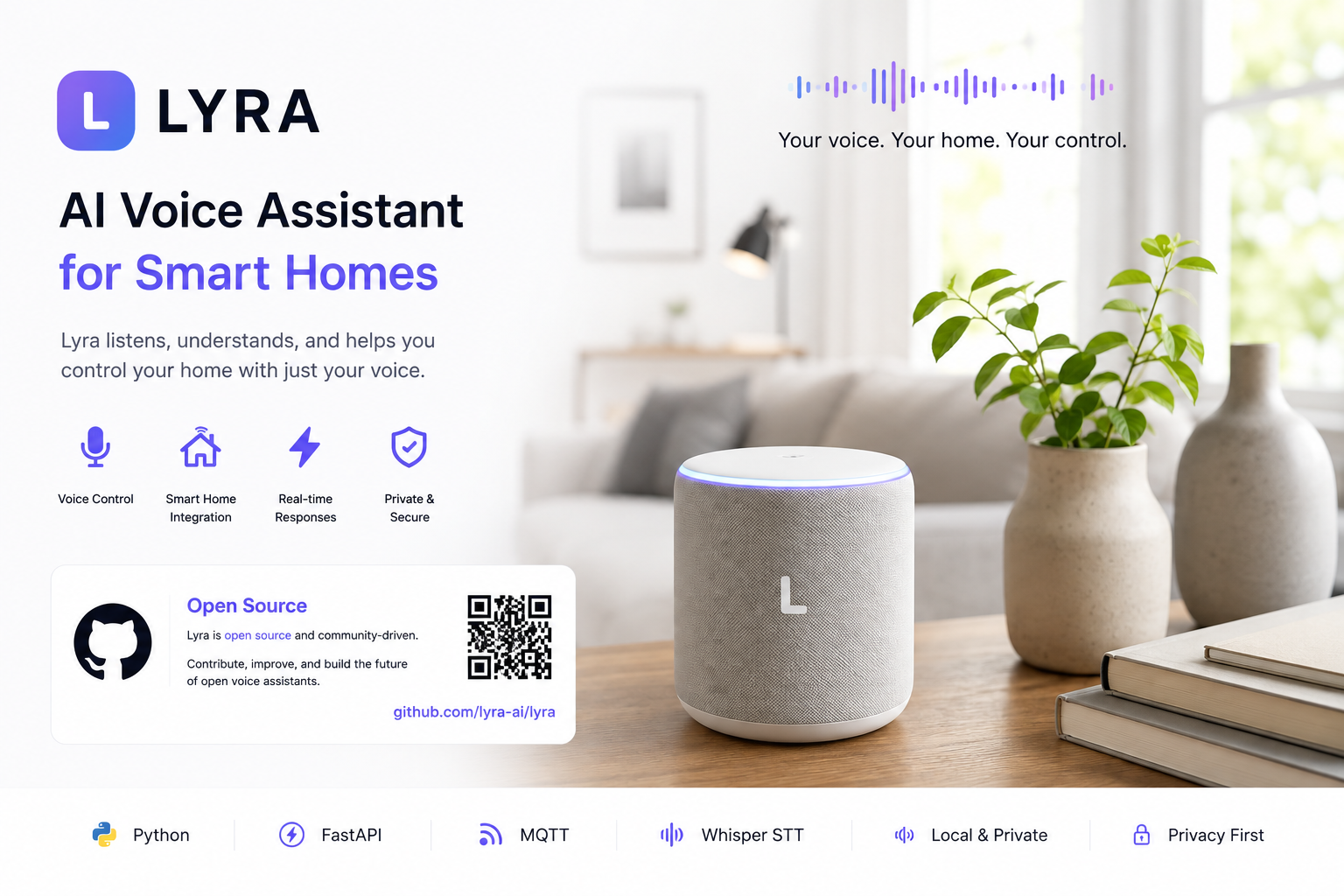
A fully offline, privacy-first smart home voice assistant.
- Role
- Architecture, NLP engineering, full stack
- Year
- 2026
- Status
- Open Source · MIT
Overview
Mainstream voice assistants are convenient and deeply compromised. Every command is a recording sent to someone else's server, retained under someone else's policy, and processed on someone else's schedule.
Lyra is the alternative: a complete voice pipeline — wake word, speech-to-text, language understanding, device control and text-to-speech — that runs entirely on local hardware. Your voice never leaves your house.
The problem
Cloud voice assistants require a permanent internet connection, have recurring costs, and send every spoken command to a remote server with no guarantee about retention or use.
Open-source alternatives exist but are fragmented — assembling wake word detection, STT, NLU, device control and TTS into a working system is a project in itself.
What I built
A six-tier NLP cascade resolves most commands without any model call at all: regex patterns, context rules and deterministic logic handle the common cases, and a local GGUF small language model handles only what the simpler tiers cannot.
Twenty device types are supported — lights, AC, fans, TVs, locks, curtains, sensors and more — with automation modes, multi-room control, comfort verbs like 'warmer' and 'dimmer', and a browser-based admin dashboard with real-time device state.
How it works
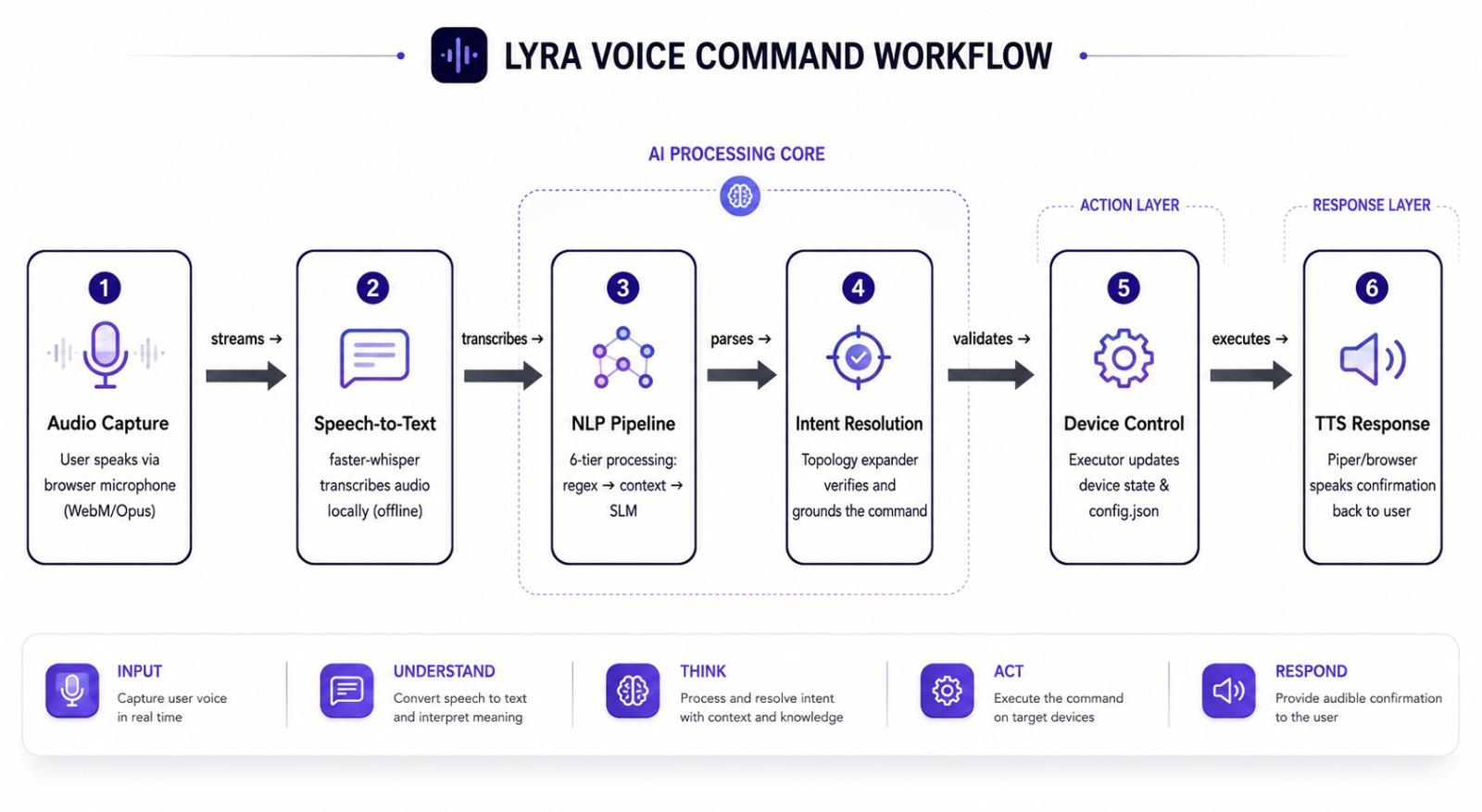
The path a single request takes through the system.
- 01
Listen for wake word
A tiny Whisper model watches the microphone continuously for 'Hi Lyra', with edit-distance tolerance for STT slips.
- 02
Transcribe the command
Once triggered, a larger Whisper model transcribes the spoken command locally — no audio leaves the device.
- 03
Understand intent
A six-tier NLP cascade — regex, context, synonyms, comfort verbs, topology validation, and a local SLM fallback — resolves the command.
- 04
Control devices
Parsed intents are validated against the real home topology and executed on target devices via the Python control engine.
- 05
Speak confirmation
Piper TTS streams a spoken confirmation back to the user through the browser, with Web Speech API as fallback.
Capabilities
Fully offline
Every stage runs on your hardware — works during internet outages, zero recurring cost.
Six-tier NLP
Most commands resolved without any model call; local SLM handles only the complex remainder.
20 device types
Lights, AC, fans, locks, curtains, sensors, cameras, garage doors and more.
Automation modes
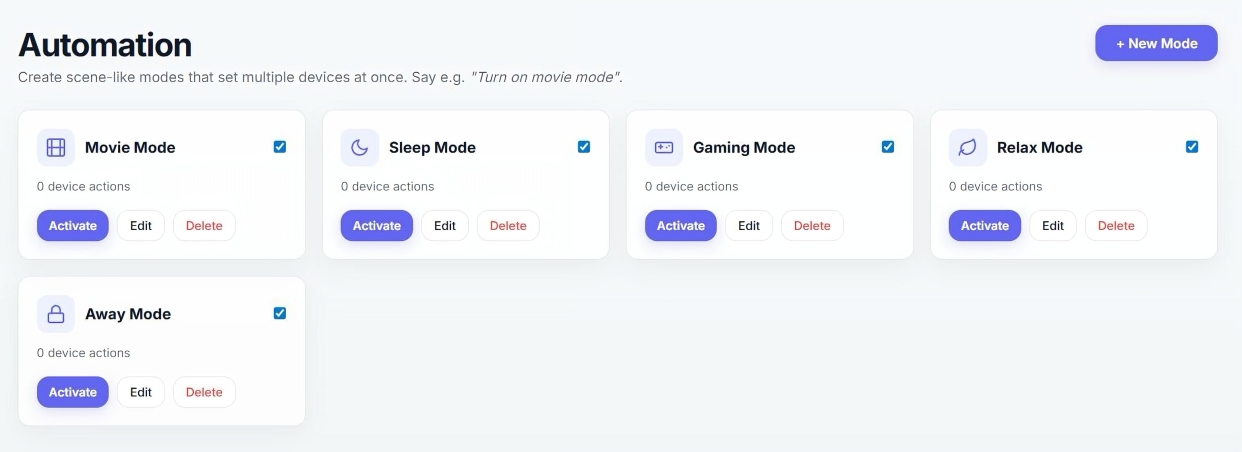
Scene-like modes — movie, sleep, gaming — activated by voice with single-active enforcement.
Browser dashboard
Real-time device status, room management, automation editor and voice control in one UI.
Multi-room control
Natural commands like 'turn off all the lights downstairs' scoped to real topology.
The product
Screens captured from the live site.
Technology
- Python
- Faster-Whisper
- llama.cpp
- Piper TTS
- Socket.IO
- React
- MQTT
- ONNX Runtime
- Docker
What changed
- A complete, working voice assistant — 19,000 lines of Python, a 5,800-line browser front-end — released as open source under MIT.
- Zero cloud dependency: no accounts, no subscriptions, no telemetry, no vendor lock-in.
- The six-tier cascade keeps latency low — most commands never reach the language model at all.
Next case study
Luxora Studio