- Role
- Product, RAG engineering, full stack
- Year
- 2026
- Status
- Live
Overview
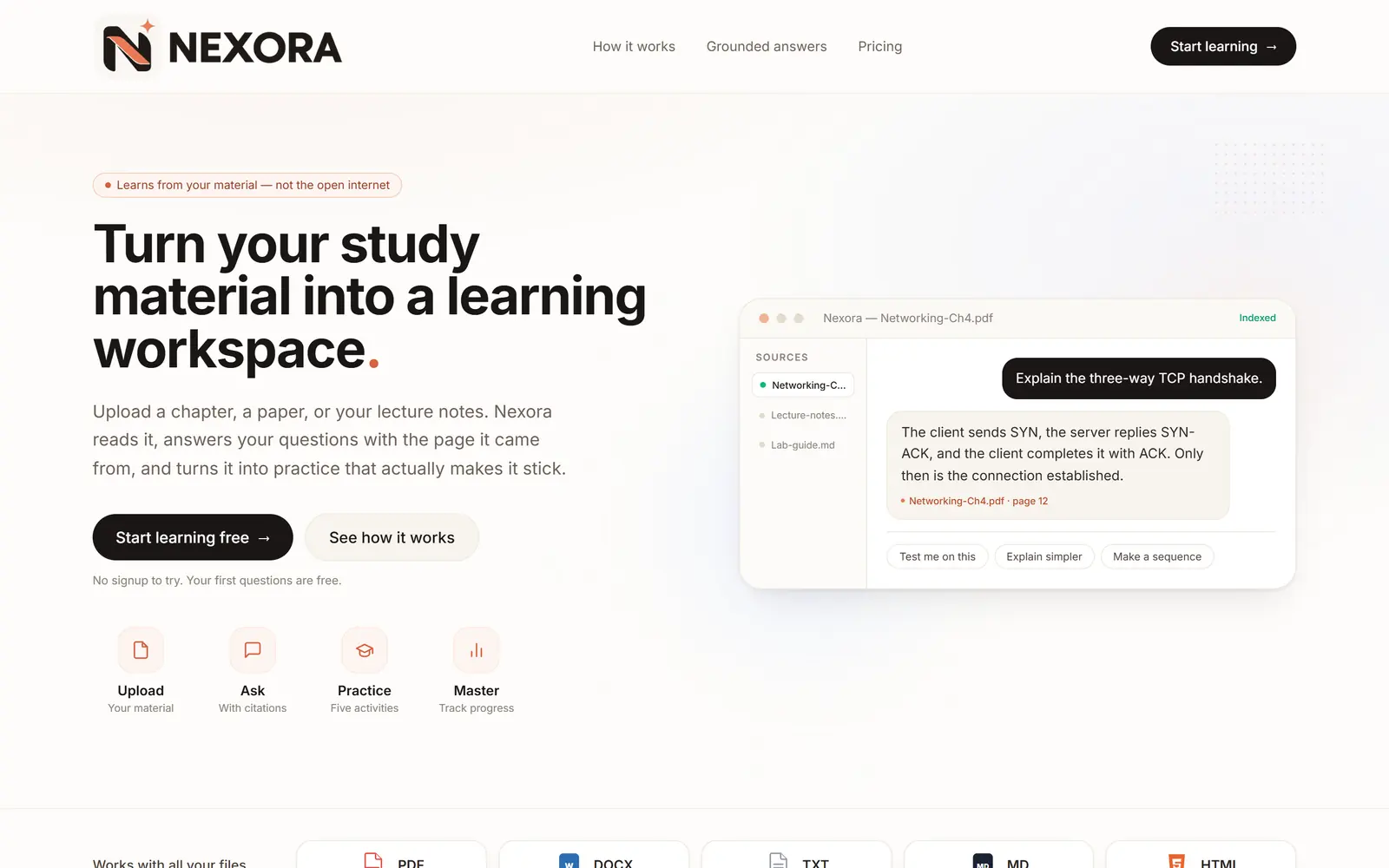
General chatbots will happily answer a question about your lecture notes without ever reading them. For studying, that is the one thing you cannot allow: an answer you cannot check is worse than no answer.
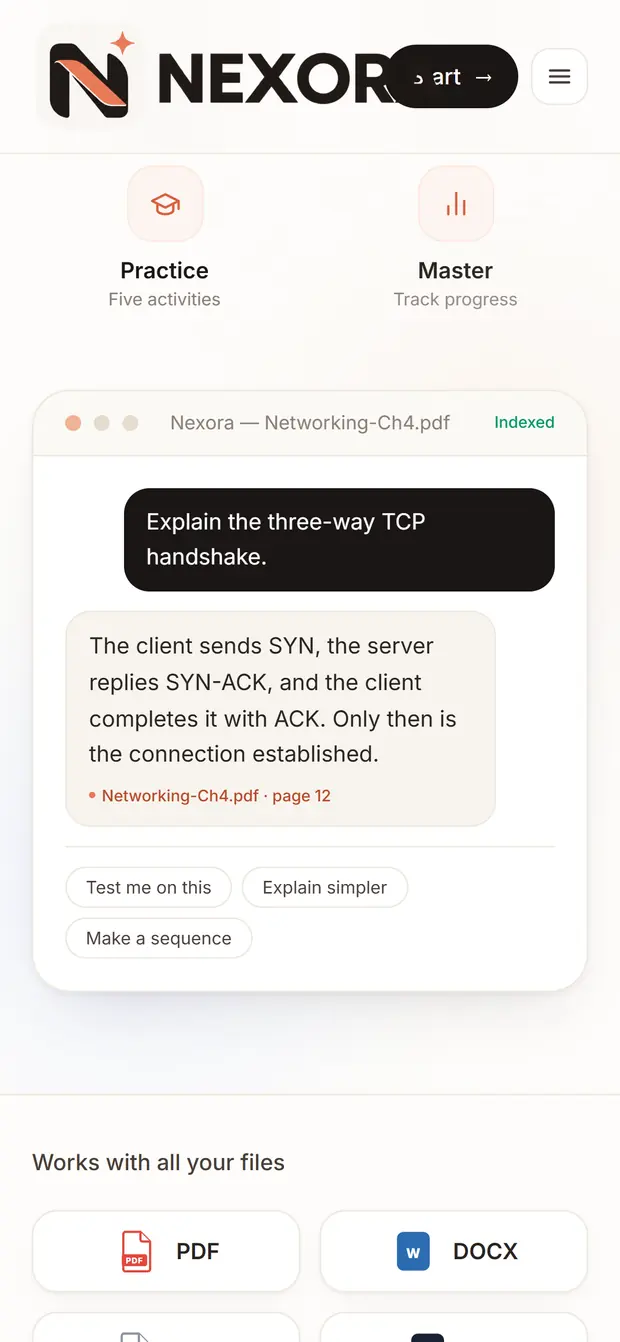
Nexora indexes the documents you upload — including scanned PDFs — and answers strictly from them, with a citation to the passage and page. The same index then generates practice activities from the material you are actually being tested on.
The problem
Students revise by rereading. It feels productive and produces almost no recall, and there is no signal about which ideas are actually weak.
AI tools that could help are not trustworthy for this: they answer from the open internet, blur sources, and produce practice questions that have nothing to do with the assigned material.
What I built
A retrieval pipeline built for documents that are messy in practice: OCR for scanned pages, metadata-aware chunking, embeddings in a vector store, and hybrid semantic plus keyword retrieval with re-ranking before anything reaches the model.
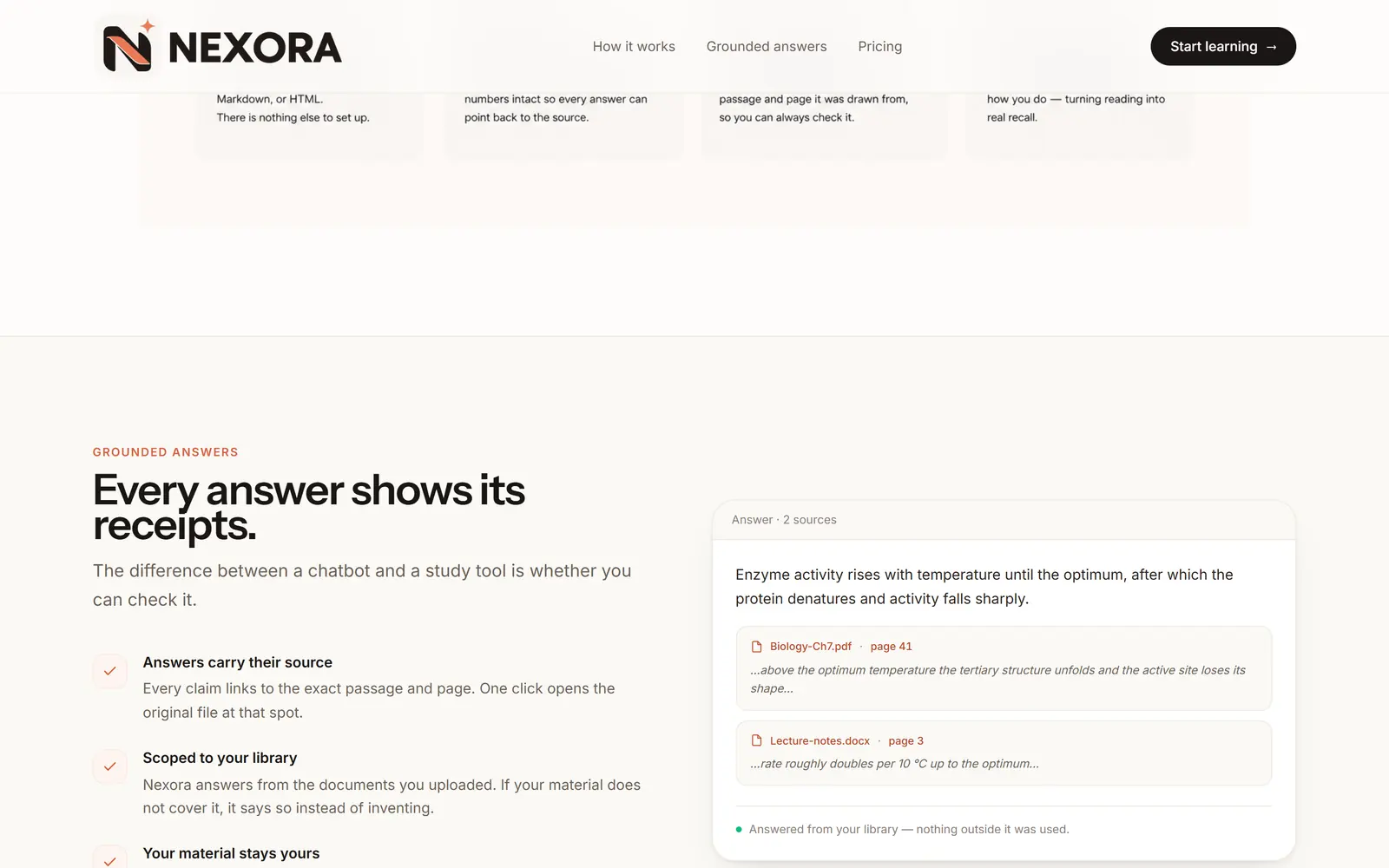
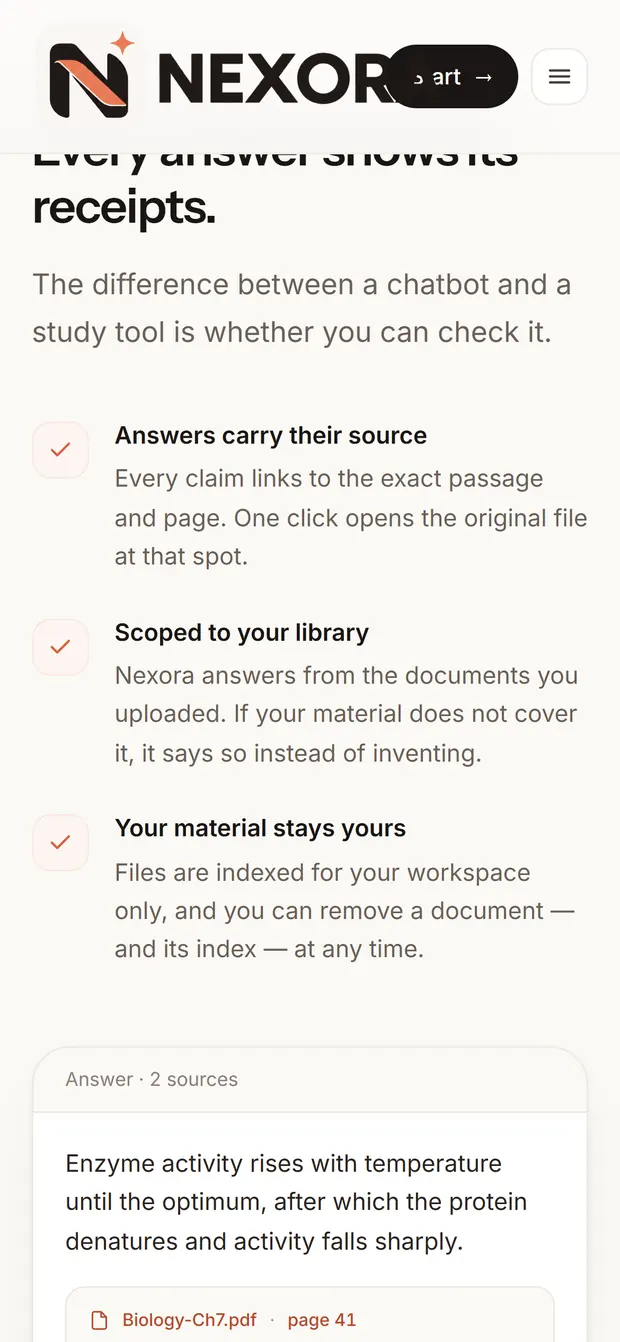
Every answer carries its receipts — the source file and page, with one click back to the original document. If the library does not cover the question, the system says so instead of inventing an answer.
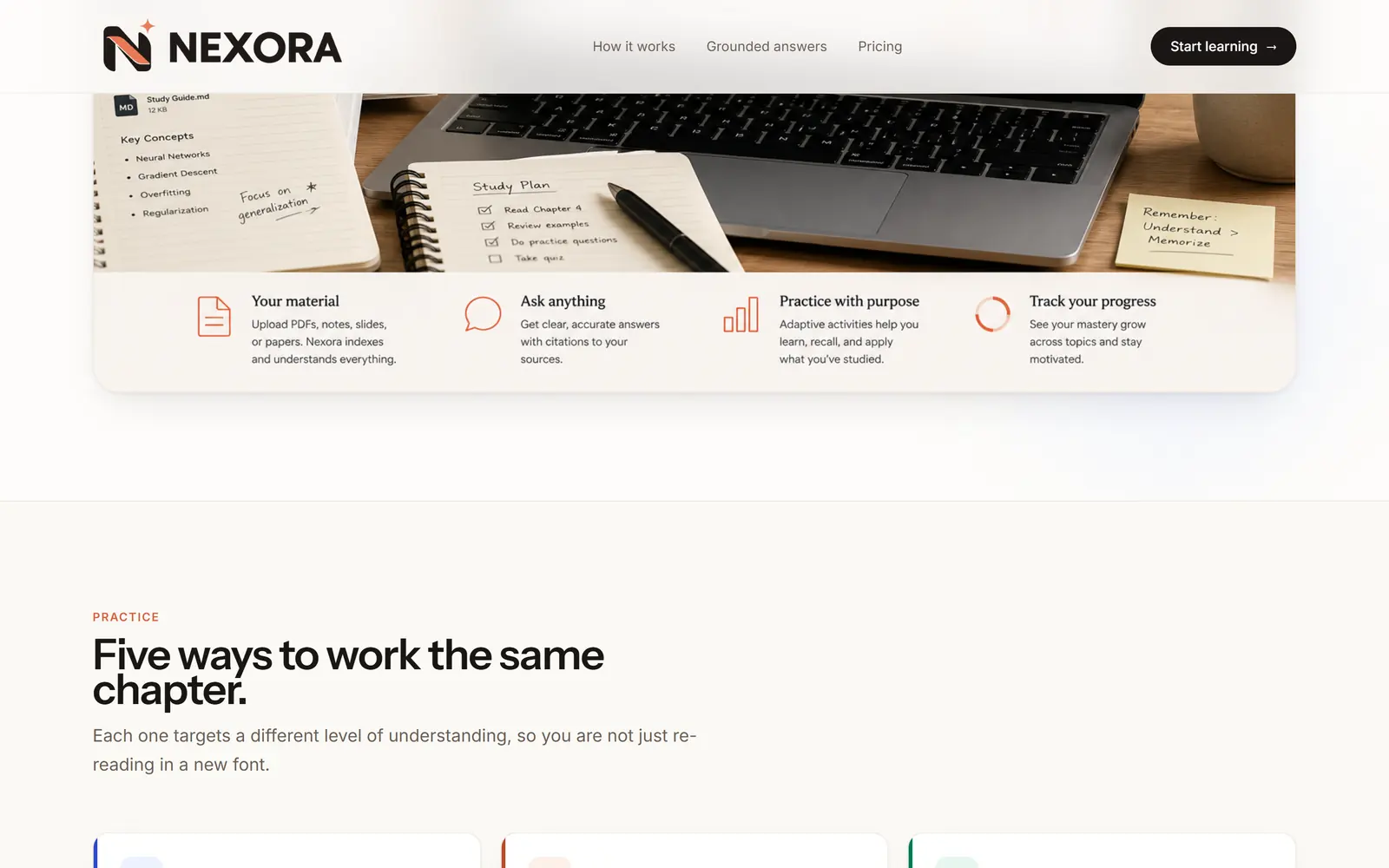
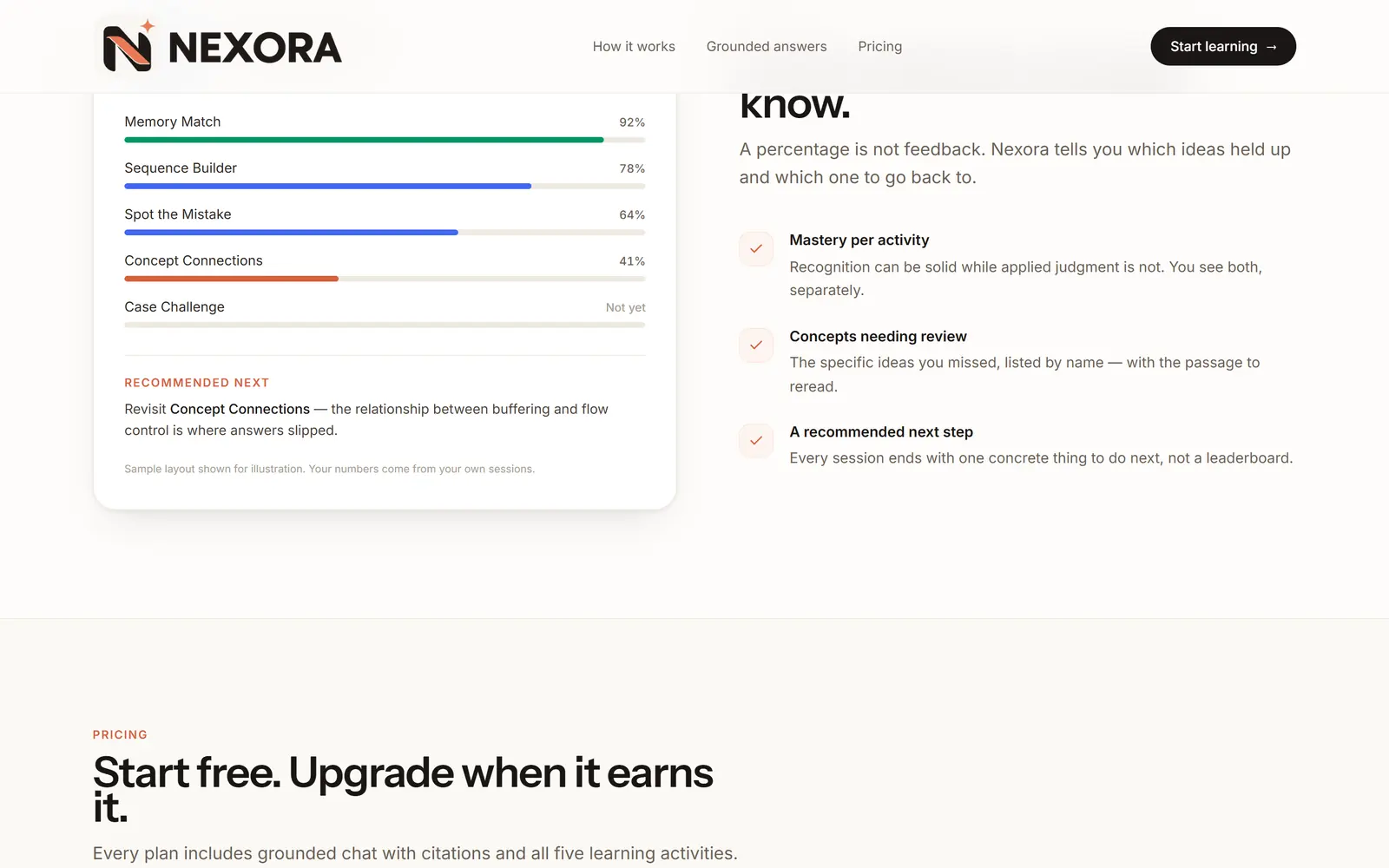
On top of the same retrieval layer, five activity types are generated on demand from the user's own document, each targeting a different level of understanding, with mastery tracked per activity.
How it works
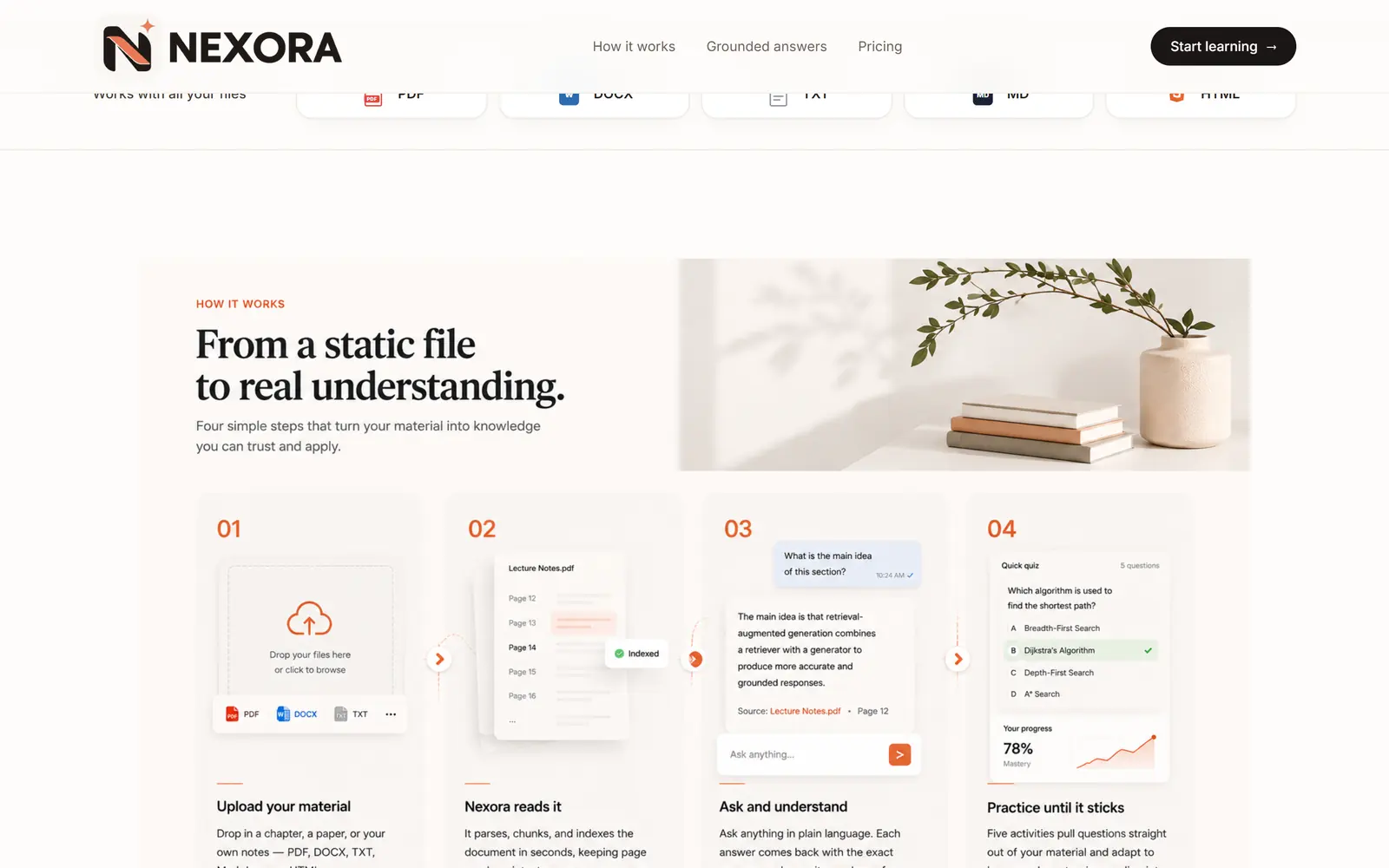
The path a single request takes through the system.
- 01
Ingest
PDF, DOCX, TXT, MD and HTML uploads are parsed; scanned pages go through OCR so image-only material is searchable too.
- 02
Chunk and embed
Documents are split with their structure and page numbers preserved, embedded, and stored in a vector database scoped to the user's workspace.
- 03
Retrieve hybrid
Questions run through semantic and keyword retrieval together, and candidate chunks are re-ranked so the strongest evidence reaches the model.
- 04
Answer with citations
Generation is constrained to retrieved context; each claim is returned with its source file and real page number, resolved from the database rather than generated.
- 05
Practice and track
The same grounded context generates five activity types per document, and results are rolled up into per-activity mastery and a concrete next step.
Capabilities
Page-level citations
Answers link to the passage and page, and open the original file at that spot.
OCR for scanned material
Photographed and scanned chapters become searchable instead of dead weight.
Hybrid retrieval + re-ranking
Semantic and keyword search combined, then re-ranked before generation.
Five practice activities
Recognition, critical review, systems thinking, procedure and applied judgement.
Scoped to your library
Out-of-scope questions are refused rather than answered from the open internet.
Mastery reporting
Progress per activity type, with the specific concepts to revisit.
The product
Screens captured from the live site.
Technology
- TypeScript
- React
- Node.js
- PostgreSQL
- Supabase
- Vector search
- OCR
- Embeddings
- Hybrid retrieval
- Re-ranking
- LLM APIs
- Cloudflare
What changed
- Answers are traceable end to end: every citation resolves to a real page in a real uploaded file.
- Scanned, image-only course material becomes usable — the part most study tools quietly skip.
- One upload produces both grounded Q&A and five distinct practice formats, so revision is active rather than rereading.
Next case study
Scouts AI